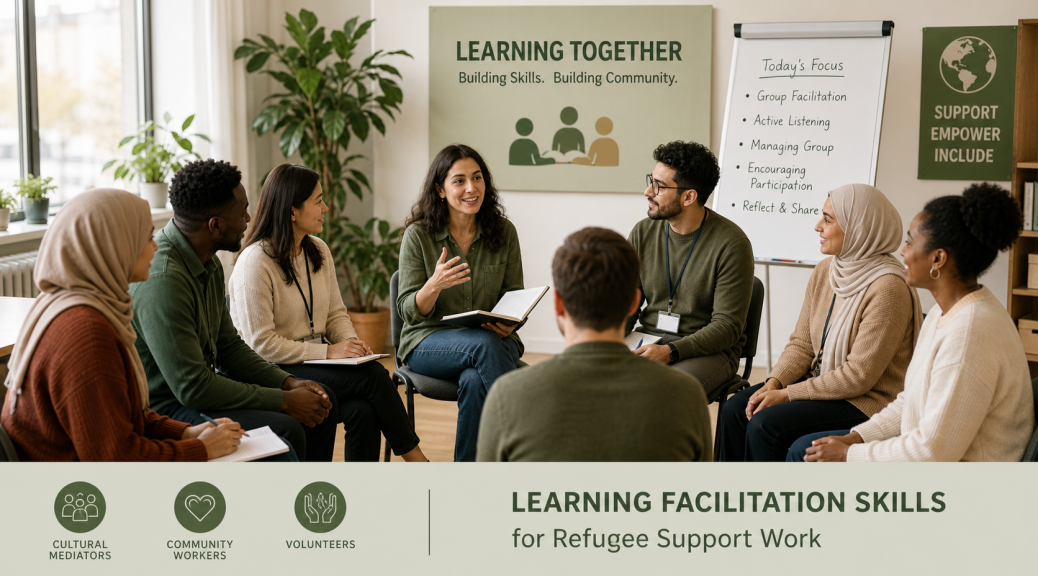
Training Non-Specialist Facilitators to Deliver Mental Health Support to Refugees: A Practical Guide
Delivering mental health support to refugees and asylum seekers doesn’t always require specialist mental health professionals. Trained non-specialist facilitators—such as cultural mediators, community workers, or volunteers with a refugee or migrant background—can effectively deliver scalable psychological interventions like Self-Help Plus (SH+). This guide explains who can be trained, what training covers, how facilitators are supported, and what works in practice for organisations working with displaced populations in the UK and Europe.
Who can become a non-specialist facilitator?
Non-specialist facilitators do not need to be mental health professionals. The key requirement is that they receive structured training and ongoing support to deliver the intervention safely and effectively. Suitable candidates typically include:
- Cultural mediators who work with refugee and migrant communities
- Community workers employed by refugee support organisations
- Volunteers with a refugee or migrant background from the same or similar culture as participants
- Social workers, caseworkers, or integration support staff who already work with asylum seekers
- Healthcare assistants or primary care staff in settings serving displaced populations
In the RE-DEFINE project, facilitators were specifically chosen to have a refugee or migrant background, or to share the same or similar culture as the participants. This helps ensure cultural sensitivity and that participants feel understood. Gender, age, language, and religious background also matter when matching facilitators to groups.
What matters most is not prior mental health training but qualities such as empathy, reliability, cultural competence, and the ability to work respectfully with diverse groups. Facilitators should be comfortable listening, managing group dynamics, and following a structured protocol.
What does facilitator training cover?
Training for non-specialist facilitators is structured and practical. It focuses on delivering the intervention according to a clear protocol rather than providing therapy. Typical training covers:
- Understanding the intervention: What SH+ or similar programmes are, who they are for, and what they are not designed to do
- Basic stress and distress concepts: How to recognise psychological distress, common symptoms, and when distress may indicate a need for specialist care
- Group facilitation skills: How to run a session, manage time, encourage participation, and handle difficult situations
- Running audio sessions: How to set up equipment, play recordings, and guide discussion after listening
- Supporting participants: How to respond to questions, encourage practice of techniques, and maintain a supportive atmosphere
- Boundaries and safety: What facilitators should and should not do, when to refer to specialist services, and how to handle disclosures of serious harm
- Cultural adaptation: How to adapt language, examples, and approach while staying within the intervention protocol
- Monitoring and recording: How to track attendance, complete basic outcome measures, and report issues
Training typically lasts 2 to 5 days, depending on the intervention. It includes both theoretical learning and practical exercises, such as role-playing sessions and practice runs. Some programmes also include supervised practice before facilitators run groups independently.
How are facilitators supported after training?
Training alone is not enough. Non-specialist facilitators need ongoing support to deliver interventions effectively and avoid burnout. Common support mechanisms include:
- Regular supervision: Weekly or monthly meetings with a supervisor (often a mental health professional or senior practitioner) to discuss challenges, review progress, and receive guidance
- Peer support: Opportunities to connect with other facilitators for shared learning and emotional support
- Refresher training: Short sessions every 6 to 12 months to maintain skills and update knowledge
- Clear protocols: Written guidance on what to do in different situations, including when to refer participants to specialist services
- Access to advice: A named contact who facilitators can reach out to when they encounter problems
Support is especially important because facilitators may encounter participants with high distress, trauma histories, or complex needs. Without adequate support, facilitators risk becoming overwhelmed or providing care beyond their capacity.
What interventions can non-specialists deliver?
Non-specialist facilitators can deliver several WHO-developed scalable psychological interventions, including:
- Self-Help Plus (SH+): A group self-help intervention using a self-help book and weekly audio sessions for people with high distress but no diagnosed disorder
- Problem Management Plus (PM+): A five-session individual or group intervention teaching practical strategies to manage stress, problems, and symptoms
- Step-by-Step: A five-session psychological intervention for adults with depressive symptoms, delivered by trained non-specialists
These interventions are designed specifically to be delivered without specialist mental health training. They follow structured protocols that facilitators are trained to implement. This differs from open-ended psychotherapy, which requires specialist qualifications.
Non-specialists may also deliver psychosocial support activities such as group discussions, stress management workshops, or peer support groups, though these may not be formal WHO interventions.
Why use non-specialist facilitators for refugee support?
There are several practical reasons for using non-specialist facilitators when working with refugees and asylum seekers:
- Accessibility: Specialist mental health services are often scarce, expensive, or have long waiting times. Non-specialist facilitators can expand access to support.
- Cultural competence: Facilitators from the same or similar cultural background help reduce language barriers and build trust with participants.
- Cost-effectiveness: Training non-specialists is more affordable than employing specialist clinicians, making it easier to scale support programmes.
- Reduced stigma: Some people are reluctant to seek mental health care from specialist services. Group-based support delivered by community workers may feel less stigmatising.
- Integration with existing services: Facilitators who already work with refugees (as caseworkers, cultural mediators, or volunteers) can integrate mental health support into their existing roles.
Research from the RE-DEFINE project and other trials has shown that non-specialist delivered interventions can reduce psychological distress, disability, and health costs. The main objective of health economic evaluations is to determine whether implementation reduces the economic burden of common mental health symptoms in refugees and asylum seekers.
What are the limitations?
Non-specialist facilitators are not suitable for all situations. Important limitations include:
- Not for severe mental illness: These interventions are designed for people with high distress but no diagnosed mental disorder. People with severe depression, PTSD, or other conditions need specialist care.
- Not therapy: Facilitators do not provide psychotherapy. They deliver structured interventions following a protocol.
- Dependence on support: Without adequate supervision and training, facilitators may struggle with complex cases or become overwhelmed.
- Quality varies: The effectiveness of the intervention depends on how well facilitators are trained and supported. Poorly implemented programmes may not achieve expected outcomes.
- Not a replacement for specialist services: Scalable interventions should complement, not replace, access to specialist mental health care for those who need it.
Organisations need to be clear about what facilitators can and cannot do, and ensure there is a pathway to specialist services for participants who need it.
How does this work in the UK context?
In the UK, refugee and migrant mental health support is provided by a range of organisations including the NHS, local authorities, refugee councils, and community organisations. While WHO scalable interventions like SH+ are not yet widely implemented in mainstream NHS services, the principles they embody align with approaches used in talking therapies and community mental health initiatives.
UK organisations working with refugees may consider training staff or volunteers to deliver similar interventions. This could be part of:
- Refugee support programmes run by local authorities or integrated care boards
- Community mental health initiatives in areas with high refugee populations
- Voluntary sector programmes funded by grants or charitable donations
- Integration support services that include psychosocial elements
The European Union Agency for Asylum (EUAA) has highlighted mental health conditions and needs in the asylum procedure as an important issue, with guidance including practical guides on mental health and well-being for applicants for international protection. While the UK is no longer in the EU, these principles remain relevant for UK organisations.
Training non-specialist facilitators also aligns with NHS priorities around expanding access to talking therapies and reducing waits for mental health support. The approach could be considered for refugee and migrant support services as part of broader mental health strategy.
What training organisations should consider
Before training non-specialist facilitators, organisations should consider:
- Is there a clear need? Assess whether there is demand for psychological support among the refugee and migrant population you serve.
- Which intervention fits? Choose an intervention that matches your population’s needs and your organisational capacity.
- Who will be trained? Select candidates with appropriate backgrounds, languages, and qualities.
- How will you support them? Plan for supervision, peer support, and refresher training.
- What about referrals? Ensure there is a pathway to specialist services for participants who need more than the intervention provides.
- How will you monitor outcomes? Decide what data to collect and how to evaluate whether the programme is working.
- Is funding secure? Training and ongoing support require resources. Consider whether funding is available for the full programme, not just initial training.
Common misconceptions
There are several misunderstandings about non-specialist facilitators:
- “They don’t need any training.” Training is essential. Facilitators need structured training and ongoing support to deliver interventions safely and effectively.
- “They can provide therapy.” Facilitators deliver structured interventions following a protocol. They do not provide open-ended psychotherapy.
- “They can work with anyone.” Interventions are designed for people with high distress but no diagnosed mental disorder. People with severe conditions need specialist care.
- “One training session is enough.” Facilitators need ongoing supervision, peer support, and refresher training to maintain skills.
- “They replace specialist services.” Scalable interventions complement specialist services, not replace them.
FAQs
How long does facilitator training take?
Training typically lasts 2 to 5 days, depending on the intervention. It includes theoretical learning and practical exercises such as role-playing and practice sessions. Some programmes also include supervised practice before facilitators run groups independently.
Do facilitators need mental health qualifications?
No. Non-specialist facilitators do not need mental health qualifications. They need structured training in the specific intervention, along with ongoing supervision and support. Relevant backgrounds include community work, cultural mediation, or volunteer work with refugee populations.
Can volunteers become facilitators?
Yes, volunteers can become facilitators if they receive proper training and ongoing support. Volunteers with a refugee or migrant background from the same or similar culture as participants are often well-suited. However, organisations need to ensure volunteers have the time, reliability, and commitment required.
What happens if a participant needs specialist care?
Facilitators should have clear protocols for referring participants to specialist services. This includes knowing when distress may indicate a diagnosed disorder, how to make referrals, and how to support participants through the process. Organisations need to ensure there is an accessible pathway to specialist mental health care.
Is facilitator training paid or voluntary?
It depends on the organisation. Some employ facilitators as staff and pay for their time during training. Others train volunteers, who may receive training but not payment for sessions. In both cases, organisations should cover training costs and provide ongoing support.
How do I find training programmes for facilitators?
Training for WHO scalable interventions is often provided by organisations that have implemented the programmes, academic institutions, or mental health training providers. In the UK, organisations may contact refugee support networks, mental health charities, or public health bodies to explore training options. The WHO also publishes implementation guidance for some interventions.
Training non-specialist facilitators offers a practical way to expand mental health support for refugees and asylum seekers. It requires careful planning, quality training, and ongoing support, but it can make psychological care more accessible, culturally appropriate, and cost-effective for displaced populations.